

Strategy playbooks are everywhere—models can sketch market moves in minutes, and many large operators chase the same “top-five” priorities. The edge is shifting to two things: how much change an organization can absorb and how quickly it can move once a decision is made.
Exposure Is Showing Up in Leaders’ Own Words
- “Too many areas of our product strategy have been designated as priorities. This has caused operational inefficiency and a strain on resources,” said Kevin Plank, CEO of Under Armour.
- Similarly, Procter & Gamble’s CFO, Andre Schulten, emphasized the need for focus: “We’re staying disciplined—fewer, bigger, better initiatives so we don’t dilute execution.”
Research supports these concerns: According to Prosci, more than half of large companies already operate at—or beyond—their capacity for new initiatives. Meanwhile, Gartner identifies “project overload” as one of the top barriers to achieving digital outcomes.
Even the Best Strategies Can Break Down During Execution
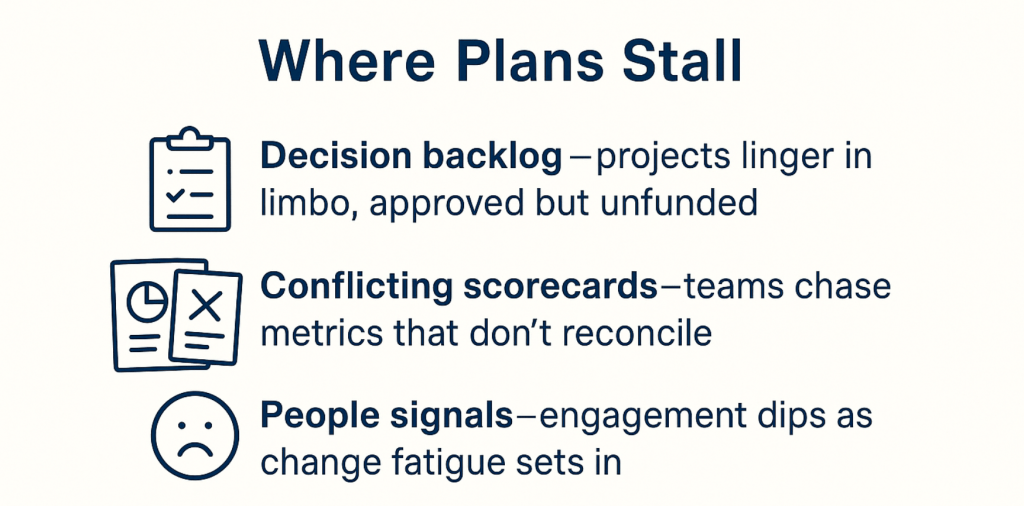
- A common culprit is the decision backlog—initiatives are approved but left unfunded or delayed indefinitely, causing momentum to stall.
- Conflicting scorecards can also undermine progress, as teams chase metrics that don’t align across departments, leading to confusion and misaligned priorities.
- Then there are the people signals—a drop in engagement, rising frustration, and the onset of change fatigue, all of which quietly erode the organization’s ability to execute.
It’s no surprise that 70% of large transformations miss their targets—most often because timelines stretch and resources fragment.
A Quick Capacity Check
A quick way to assess your team’s capacity is to step back and map out what’s already in motion:
- List every initiative slated for the next 12 months
- Score each one with a rough estimate of effort or lead time
- Sequence initiatives by value × feasibility, and pause low-impact work
- Run in two-week rhythms so plans move quickly from concept to execution
Walmart used a similar approach when piloting its InHome delivery service in three cities. After validating labor and routing capacity, they scaled nationwide in under six months—boosting route density and improving efficiency along the way.
Speed Now Carries a Premium
Under Armour’s promise to cut its style count by 25 percent signaled sharper focus; analysts pressed for timing and milestones, and shares rallied once the roadmap was clear. Companies reporting integrations ahead of schedule increasingly earn an execution premium, while firms citing overload face tougher questions on guidance.
A simple Path from Idea to Value
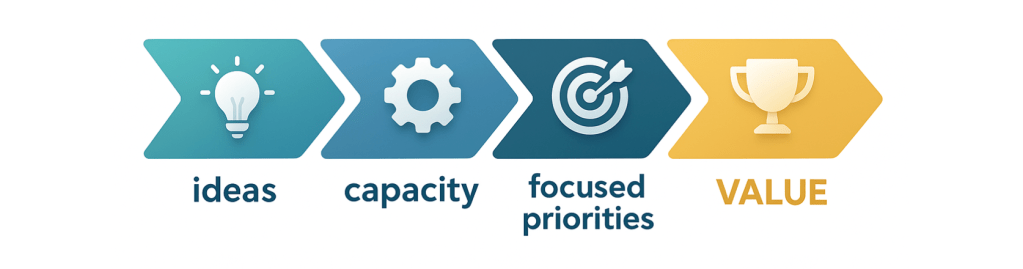
Ideas are everywhere—but value goes to the teams that manage capacity, stay focused, and move fast.
More leaders are now asking, “Can we absorb this?” before “Is it a good idea?” The shift from strategy to execution is real—so how are you testing your team’s capacity and speed today?