
Remember paying a nickel deposit on a soda can? Extended Producer Responsibility (EPR) brings that idea to packaging—only the brand pays. Starting next year, five U.S. states will bill companies for every pound of cardboard, plastic, glass, or metal they sell. If your products move through Oregon, Colorado, California, Minnesota, or Maine, those invoices are already on the calendar.
EPR in plain English: a prepaid recycling tab
EPR shifts the cost of recycling from taxpayers to the companies that place packaging on shelves. Think of it as adding a pre-paid return ticket to every box that leaves your distribution center. Packaging now carries an end-of-life surcharge that flows straight into cost of goods.
Key dates and states to watch
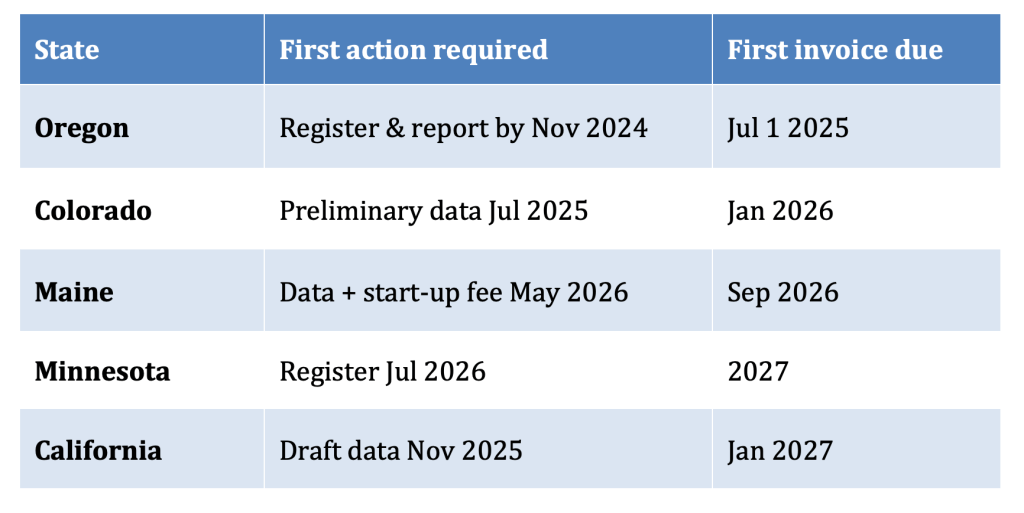
Managing reporting across five separate portals can lead to missed deadlines and administrative headaches. A single national SKU may trigger five invoices by 2027.
Does this apply to your brand? If your annual U.S. revenue tops $1–2 million or you ship more than one short ton of packaging into any participating state each year, you fall inside the rules. Brands moving only cottage-scale volumes may qualify for exemptions, but anything filling more than a single box truck of product is almost certainly covered.
How the numbers add up
Canadian programs charge ≈ CA ¢34 per kg (≈ US $0.15/lb) of corrugate. A snack brand shipping 30 million lbs of boxes into the five early states would owe about US $4 million per year, roughly a two-point EBITDA hit before any design changes. Fees of this size rival a mid-level promotion budget and demand board-level attention.
One EZ-Pass for data and payments
All early-adopter states selected Circular Action Alliance (CAA) as their Producer Responsibility Organization. Using CAA is like driving with an EZ-Pass: one transponder, many toll booths. Clean, SKU-level data transforms a single upload into seamless compliance, eliminating weeks of spreadsheet triage.
Five moves to take this quarter

Compliance can become a competitive edge
Getting ahead of EPR lets brands convert a looming fee into a manageable line item. By weaving projected costs into 2026–28 sourcing and costing models now—and redesigning packaging where it makes financial sense—companies can keep margins neutral and avoid last-minute price shocks. Early preparation also streamlines data collection, cutting future administrative work when state invoices arrive.
Are you treating EPR as just another cost or a chance to outmaneuver competitors before the bills hit?